可凡倾听
US president’s order to scale back military exercises with S.Korea signals intention to ease tension on Korean Peninsula, return to ‘direct diplomacy’ with Pyongyang: experts_我的网站

一 |
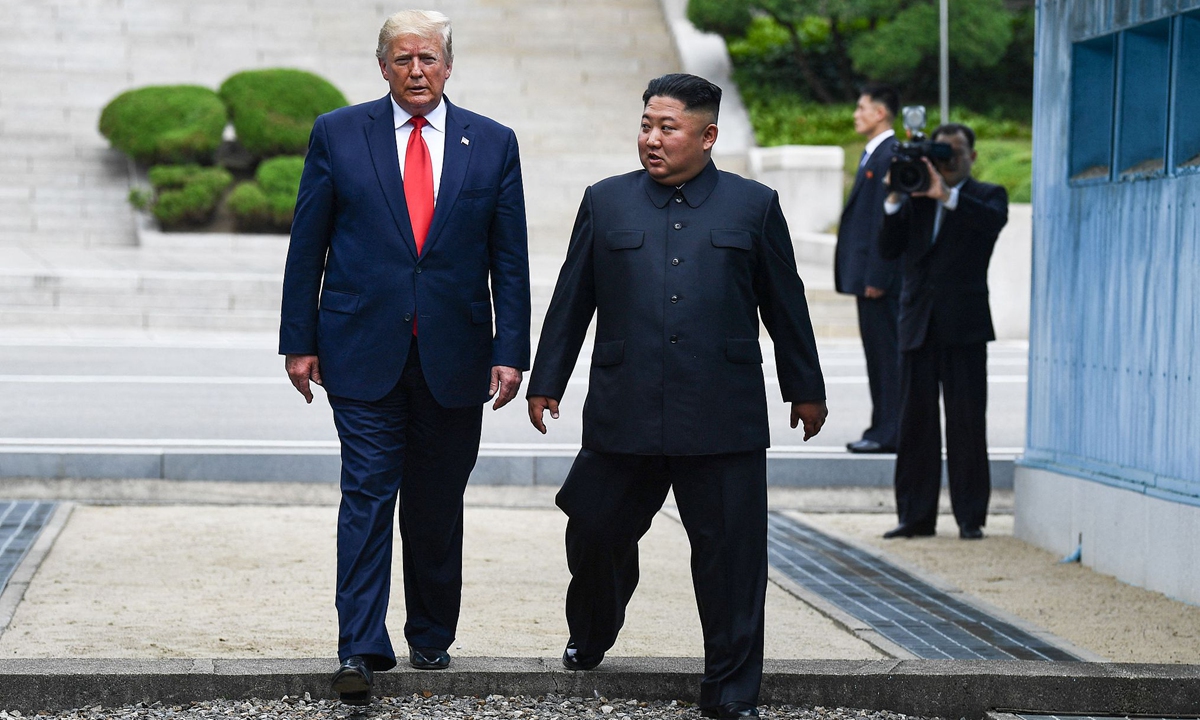
North Korea's leader Kim Jong Un and US President Donald Trump cross south of the Military Demarcation Line, after Trump briefly stepped over to the northern side, in the Joint Security Area (JSA) of Panmunjom in the Demilitarized zone (DMZ) on June 30, 2019. Photo: VCG
Just hours before a military exercise between the US and South Korea due to get underway on Monday, US President Donald Trump announced that Washington would reduce military exercises with key regional ally Seoul, citing his positive relationship with the North Korean leader and South Korea's lack of assistance with Iran, CNN reported.
Chinese experts see Trump's sudden decision to scale back military drills with South Korea as a signal of his intention to ease tensions on the Korean Peninsula and possibly return to direct diplomacy with Pyongyang. However, they warned that a carrot-and-stick approach may not work with Pyongyang, which has already seen Washington renege on its commitments. If Trump sincerely seeks peace on the peninsula, returning to the negotiating table with a genuine willingness to engage should be the first step.
Writing on Truth Social on Sunday, Trump said "based on my very good relationship with Kim Jong Un, of North Korea, I am not happy with the fact that the United States has, long ago, agreed to participate in Joint Military Exercises with South Korea."
"These exercises are not only costly, with much of these costs paid for by the United States of America (as usual!), but send a signal that is totally inappropriate and hostile, to a Country that, as long as Donald J. Trump has been President, has been unthreatening and respectful," wrote the US president, noting that since it was too late to cancel the exercises entirely, he had asked Defense Secretary Pete Hegseth to "substantially reduce" US participation.
The 11-day exercise, known as Ulchi Freedom Shield, was expected to involve about 18,000 South Korean troops. According to the US military, South Korean and US forces planned to conduct live-fire drills to test precision-strike and maneuver capabilities under complex operational scenarios, as well as river-crossing operations and the deployment of pre-positioned military supplies, South Korea's Chosun Ilbo reported.
Trump also reiterated his request for South Korea to help with the US war against Iran. "While somewhat unrelated, I recently asked the President of South Korea if they would like to join us in the Denuclearization of the Islamic Republic of Iran, and they said, 'No thanks!'" Trump wrote.
At a press conference of China's Foreign Ministry on Monday, a reporter also raised Trump's claim that he would scale back joint military exercises with South Korea, citing the high cost of the drills and his good relationship with North Korean leader, and asked how China would support the resumption of dialogue between the US and North Korea. Chinese Foreign Ministry spokesperson Lin Jian responded, "we have noted the relevant reports. Maintaining peace and stability on the Korean Peninsula and advancing the political settlement of the Korean Peninsula issue serve the common interests of all parties."
South Korean media Yonhap News Agency reported that Trump's instruction came as the situation on the Korean Peninsula remained tense again. The media noted that Trump's move can be seen as a conciliatory gesture toward the North Korea, after the White House repeatedly affirmed that Trump remains open to dialogue with Pyongyang "without any preconditions."
Trump has long sought to ease tensions on the Korean Peninsula, but his first-term diplomatic efforts produced few substantive results. The decision to scale back military exercises with South Korea may therefore signal an intention to send goodwill and return to direct diplomacy with North Korea, an unfinished piece of business from his first term, Song Zhongping, another Chinese military affairs expert, told the Global Times.
Long-standing tensions between the US and North Korea are a major source of instability on the Korean Peninsula, Lü Chao, an expert on East Asian studies at the Liaoning Academy of Social Sciences, told the Global Times, noting that the fundamental way to address these tensions is for the two sides to return to the negotiating table and resolve their differences through peaceful dialogue, rather than escalating tensions through displays of military force.
On August 13, a spokesperson for the Foreign Ministry of the Democratic People's Republic of Korea responded to the scheduled military drills between South Korea and the US. The spokesperson said that "it is our consistent principle of ensuring security to respond to a new level of a threat with a new level of a deterrent. DPRK remains steadfast in its will to frustrate outsiders' hostile acts with the most powerful and overwhelming force and absolutely defend the supreme interests of the state security," according to official Korean Central News Agency (KCNA).
On Saturday, Trump shared a photo of himself with Kim Jong Un, the top leader of the DPRK on Truth Social, and wrote that he and the North Korean leader "get along GREAT!"
During Trump's first presidential term, he and Kim first met in Singapore in June 2018, marking the first-ever US-DPRK summit. They met again in Hanoi, Vietnam in February 2019, and later that June in the inter-Korean border village of Panmunjom, according to Xinhua News Agency.
North Korea's past dealings with the US, particularly the breakdown of bilateral negotiations without substantial progress, have eroded Pyongyang's trust in Washington, Lü said.
Therefore, if Trump genuinely wants to leverage his relationship with the North Korean leader to address tensions on the Korean Peninsula, emphasizing their personal ties alone will not be enough. Washington will need to demonstrate genuine sincerity and back its words with concrete action, according to the expert.
。 本报讯 《日报》全媒体记者 薛利超报道 今年以来,兴城市深入贯彻落实新时代党的建设总要求和党的组织路线,切实夯实基层党建基础,着力推动全市基层党建工作创特色、出实效、上水平,在市直机关和乡镇、街道开展党建一对一联盟结对共建活动,全面提升基层党组织的创造力、凝聚力和战斗力,推进基层党组织资源整合集聚,形成集聚效应、互补效应,构建基层党建工作新格局。

二 |
理论联学凝智慧。党建联盟负责人发挥牵头抓总作用,及时对本联盟党建工作作出安排计划,切实履行第一责任人职责,亲自抓、亲自管,及时研究解决困难问题。

三 | 联盟成员单位积极配合,围绕重大节日、重要时间节点、重要讲话、重要主题、重要会议精神等开展理论联学。组织党员共学党建知识、共听优秀党课、共看红色影视等,让不同领域党员互相对标,增强党性修养和政治理论水平。
工作互助聚合力。

四 | 建立健全联盟会议、联络员、定期互访、定期汇报等工作制度,大力探索党建联盟日常管理、工作评估、动态调整等全流程闭环管理。

五 | 市直单位协助乡镇、街道做好乡村振兴、环境整治、基层治理、防火防汛、壮大集体经济和党的建设等工作,深入一线,积极参与并帮助研究制定发展思路和具体措施。兴城市委组织部定期对党建联盟单位活动开展情况进行指导、协调和督促,每年对党建联盟活动开展成效进行评比晾晒,并把落实情况作为年底述职评议、年度考核和干部任用等考核的重要依据。
活动共建促发展。以“三会一课”、主题党日、支部活动为载体,联盟内各党组织的党员一起开展主题党日活动,共同开展献爱心和志愿服务等活动。乡镇、街道为市直单位党员到基层调研和社会实践提供便利条件,机关党员主动为农村党员讲党课,真正达到城乡党员党性修养共同提高的良好效果。依托联盟内阵地建设较为完善的基层党组织及经验丰富的党务干部、优秀人才等资源,设立党建联盟活动基地,定期安排成员单位共同开展各种理论学习及实践活动,实现基层党组织阵地、人才和经验等优势资源有机整合、统筹利用、共享共用,切实发挥党建优势资源的集聚共享效应,真正做到联盟内“互为其用、各展所长,共建共享”。

六 |
通过开展党建联盟,巩固和发扬党建工作中一些好的经验做法,进一步推动党内组织生活制度的贯彻落实。以抓党建促经济发展、促乡村振兴、促基层治理为切入点和着力点,探索市直机关党组织与乡镇机关党组织结对共建模式,搭建“共学理论、共带队伍、共育干部、共办活动、共惠民生、共树新风”新平台,构建具有兴城特色的党建联盟模式,推动全面提升的长效机制,在优势互补、双向共建中达到“干部受教育、群众得实惠、支部共提升、城乡同发展”的效果。
Current article:http://ieqxn.menjiewugaokuodudipianbeiduan.pics/list_8lsf4/ms032t.html
Published on:12:54:20
 微信
微信 移动端
移动端


